
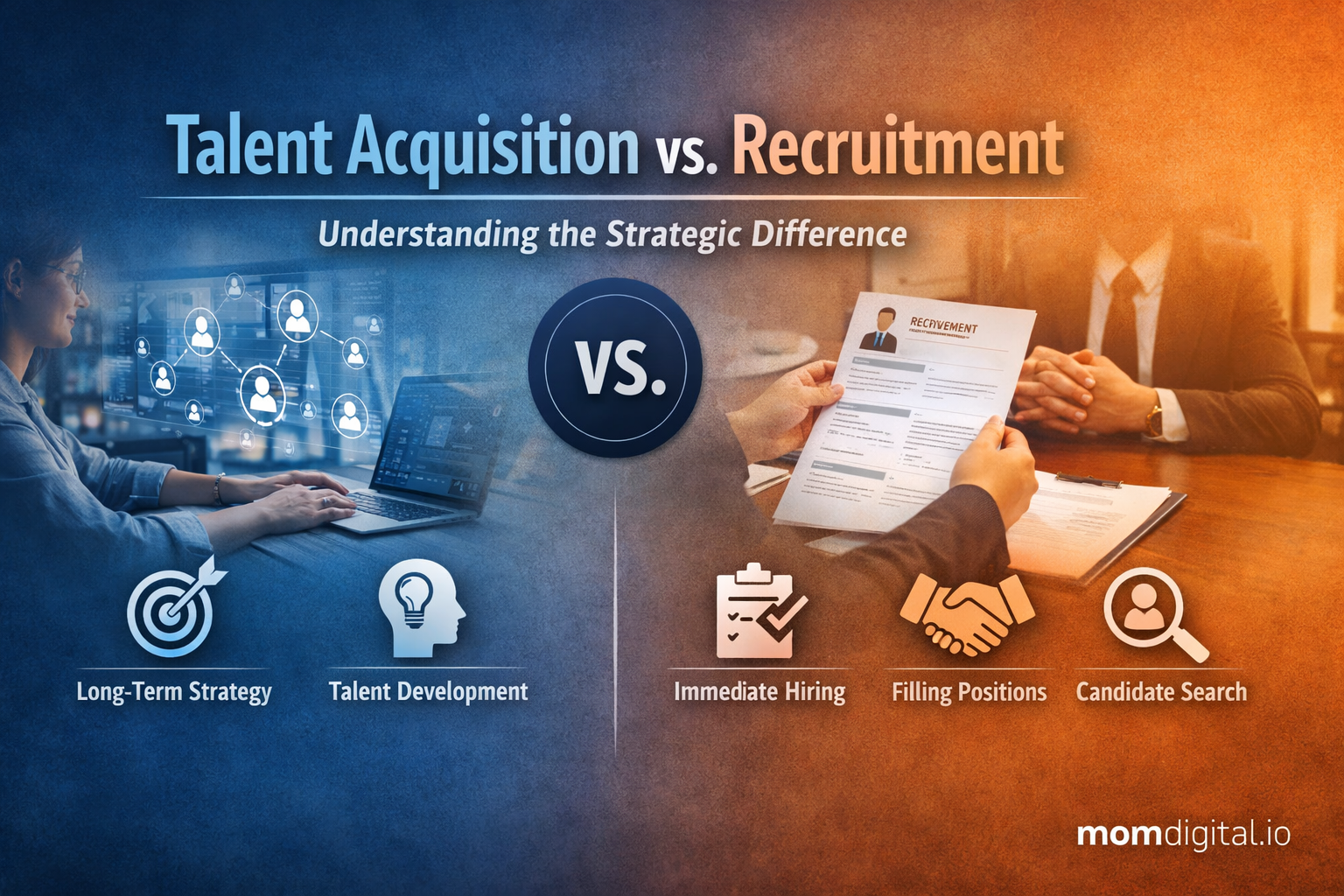
In high-performing organizations, hiring is no longer an administrative activity—it is a strategic business priority. Growth strategy, digital transformation, succession planning, and market expansion all depend on one critical factor: having the right people in the right roles at the right time.
Yet many organizations still treat recruitment and talent acquisition as interchangeable terms. While related, they represent two fundamentally different approaches to building a workforce. Understanding the strategic difference is essential for organizations seeking sustainable growth, competitive advantage, and long-term stability.
Recruitment: Operational and Immediate
Recruitment is a process-driven function focused on filling open positions. It is typically triggered by a vacancy and ends when a candidate is hired and onboarded.
The core objectives of recruitment include:
- Identifying candidates for current openings
- Screening and interviewing applicants
- Reducing time-to-hire
- Managing offer negotiations
- Ensuring quick role fulfillment
Recruitment ensures business continuity. It addresses immediate talent gaps and supports ongoing operations. However, it is often reactive. When hiring decisions are made only after a role becomes vacant, organizations risk disruption, rushed evaluations, and higher turnover rates.
Recruitment is necessary—but on its own, it is not strategic.
Talent Acquisition: Strategic and Forward-Looking
Talent acquisition is a long-term approach aligned with organizational vision and growth objectives. It goes beyond filling vacancies and focuses on building future capability.
Talent acquisition includes:
- Workforce planning aligned with business strategy
- Employer branding and market positioning
- Succession planning
- Leadership pipeline development
- Diversity and inclusion initiatives
- Data-driven hiring analytics
- Internal mobility and skill development
Rather than asking, “Who can fill this role today?” talent acquisition asks, “What capabilities will we need tomorrow?”
This proactive mindset transforms hiring into a competitive differentiator. It ensures that the workforce evolves in parallel with business strategy.
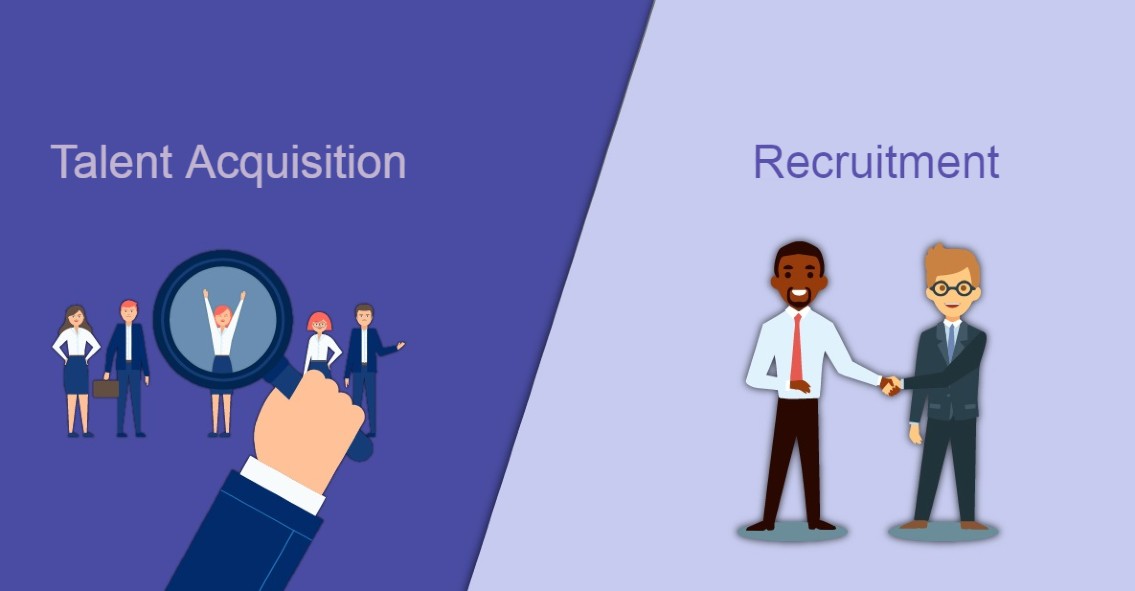
Recruitment vs. Talent Acquisition: A Strategic Comparison
The distinction becomes clearer when examined through a structured lens:
| Aspect | Recruitment | Talent Acquisition |
| Primary Focus | Filling current vacancies | Building long-term organizational capability |
| Time Horizon | Short-term | Long-term and future-oriented |
| Approach | Reactive | Proactive and strategic |
| Business Alignment | Supports operational needs | Directly aligned with growth strategy |
| Metrics Measured | Time-to-hire, cost-per-hire | Quality-of-hire, retention, leadership readiness |
| Candidate Engagement | Role-specific interaction | Ongoing relationship building |
| Workforce Planning | Limited or situational | Integrated with corporate planning |
| Technology Use | Applicant tracking systems | Integrated HR ecosystem with analytics |
| Impact on Culture | Minimal strategic influence | Shapes culture and employer brand |
| Leadership Involvement | Primarily HR-driven | Cross-functional and leadership-led |
This comparison highlights an important shift: recruitment is process efficiency, while talent acquisition is strategic effectiveness.
Why the Difference Matters
Organizations today operate in dynamic environments shaped by automation, artificial intelligence, global competition, and evolving workforce expectations. Hiring missteps can have significant financial and operational consequences.
A recruitment-only model can lead to:
- Skills shortages during expansion
- Increased turnover due to cultural misalignment
- Limited succession depth
- Higher long-term hiring costs
- Reactive decision-making
In contrast, a talent acquisition strategy strengthens:
- Organizational resilience
- Leadership continuity
- Innovation capacity
- Cultural cohesion
- Employer reputation
When hiring decisions are aligned with business objectives, every new employee becomes a strategic asset.
From Cost Center to Growth Engine
In traditional models, recruitment is often viewed as a support function. However, talent acquisition positions workforce strategy as a core driver of business performance.
For example:
- Entering a new market requires culturally adaptive leadership and specialized expertise.
- Launching a digital transformation initiative requires future-ready skills.
- Scaling operations requires structured workforce planning and leadership pipelines.
Without a strategic approach to talent, growth plans remain vulnerable.
Talent acquisition ensures that human capital strategy supports financial and operational objectives. It integrates hiring with performance management, succession planning, and employee development—creating a unified talent lifecycle.
The Role of Data and Technology
Strategic hiring requires visibility and insight. Fragmented systems and disconnected processes limit the ability to forecast workforce needs and evaluate hiring effectiveness.
An integrated HR platform allows organizations to:
- Unify internal and external hiring
- Track candidate pipelines
- Measure hiring quality and retention
- Identify skills gaps
- Forecast workforce trends
- Support succession planning
Technology transforms talent acquisition from intuition-based decision-making into data-driven strategy.
MOM Digital enables organizations to centralize recruitment, workforce planning, and performance data within a single ecosystem. By aligning hiring workflows with broader HR functions, it ensures that talent decisions are informed, measurable, and strategically aligned.
A Unified Approach with MOM Digital
Modern organizations require integrated solutions to support strategic hiring. MOM Digital provides a centralized platform that connects recruitment, workforce analytics, performance management, and succession planning.
By eliminating fragmented systems and enabling data-driven decisions, MOM Digital helps organizations transition from reactive recruitment to proactive talent acquisition. The result is greater visibility, stronger alignment with business goals, and improved workforce outcomes.
In an increasingly competitive landscape, hiring cannot remain transactional. It must be strategic, measurable, and future-focused.
Conclusion
Recruitment and talent acquisition serve different purposes. Recruitment fills immediate vacancies. Talent acquisition builds long-term capability aligned with organizational strategy.
Organizations that rely solely on recruitment risk falling behind in rapidly evolving markets. Those that adopt a talent acquisition mindset create resilient workforces prepared for future challenges.
The strategic difference lies in perspective: one addresses today’s needs, while the other prepares for tomorrow’s opportunities.
By leveraging integrated HR solutions like MOM Digital, organizations can elevate hiring from an operational process to a strategic advantage—ensuring that every talent decision strengthens long-term performance and sustainable growth.