
As businesses grow, managing employees becomes more complex. Tasks like payroll processing, attendance tracking, recruitment management, and employee record keeping can quickly overwhelm HR teams when handled manually.
Many organizations still rely on spreadsheets, paperwork, and disconnected tools for HR operations. While this approach might work for very small teams, it often leads to inefficiencies, errors, and wasted time as the company expands.
A Human Resource Management System (HRMS) helps businesses automate HR tasks, streamline operations, and improve workforce management. How can you determine when your company truly requires one?
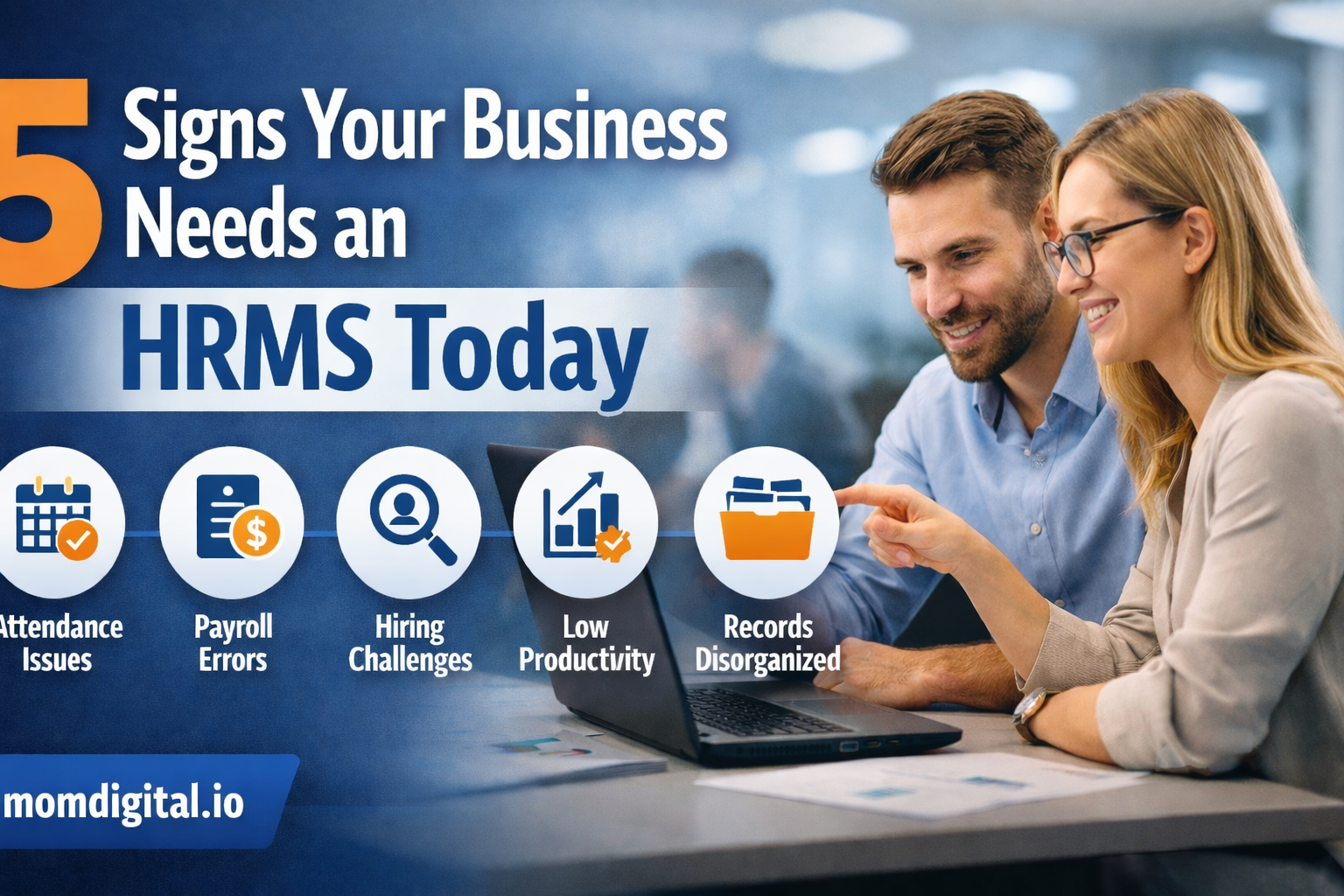
Here are five clear signs that your business needs an HRMS today.
1. Your HR Team Spends Too Much Time on Manual Tasks
One of the most common signs that a business needs an HRMS is excessive manual work. HR teams often spend hours handling repetitive administrative tasks such as:
- Calculating payroll manually
- Tracking employee attendance in spreadsheets
- Managing leave requests through emails
- Updating employee records in multiple systems
These tasks not only consume valuable time but also increase the chances of human error.
When HR professionals are stuck performing administrative work, they have less time to focus on strategic initiatives like employee engagement, performance development, and talent management.
An HRMS automates routine processes such as payroll calculations, attendance tracking, and leave approvals. This automation allows HR teams to work more efficiently and concentrate on activities that contribute to business growth.
2. Payroll Errors Are Becoming Frequent
Payroll accuracy is critical for maintaining employee trust and ensuring compliance with labor regulations. However, manual payroll systems often lead to mistakes such as:
- Incorrect overtime calculations
- Missing deductions
- Delayed salary processing
- Compliance errors
These issues can frustrate employees and create additional work for HR teams, who must correct the mistakes.
An HRMS simplifies payroll management by automatically integrating attendance records, leave data, and statutory deductions. This ensures that payroll calculations remain accurate and consistent every month.
With automated payroll systems, businesses can reduce errors, process salaries faster, and maintain better compliance with regulations.
3. Employee Data Is Difficult to Manage
As businesses grow, the number of employee records also increases. Managing this information through spreadsheets or paper files becomes increasingly difficult.
HR teams often struggle with:
- Locating employee documents quickly
- Updating personal information across multiple systems
- Managing contracts and compliance documents
- Tracking employee history and performance records
Without a centralized system, valuable information can easily become disorganized or outdated.
An HRMS provides a centralized database where all employee information is stored securely. HR teams can access and update records easily, improving both efficiency and data accuracy.
This centralized approach also ensures better security and compliance with data management practices.
4. Recruitment and Hiring Processes Are Slow
Recruitment plays a major role in business success, but many organizations experience delays due to inefficient hiring processes.
Manual recruitment systems often result in:
- Lost candidate applications
- Delayed interview scheduling
- Poor communication with candidates
- Lack of visibility into hiring progress
When recruitment becomes slow and disorganized, businesses risk losing talented candidates to competitors.
An HRMS with a recruitment module helps streamline hiring processes by centralizing candidate applications, tracking interview stages, and automating hiring workflows.
This structured approach allows HR teams to move candidates through the recruitment pipeline more efficiently, improving overall hiring outcomes.
5. Managers Lack Real-Time Workforce Insights
Effective workforce management requires access to accurate data and insights. Without proper tools, managers often struggle to track key workforce metrics such as:
- Employee attendance patterns
- Overtime hours
- Department productivity
- Employee turnover rates
When this information is difficult to access, decision-making becomes slower and less accurate.
An HRMS provides real-time dashboards and reports that help managers monitor workforce performance. With better insights, organizations can identify trends, address potential issues early, and make informed decisions about staffing and resource allocation.
Data-driven decision-making improves overall productivity and operational efficiency.
Additional Benefits of Implementing an HRMS
Beyond solving immediate HR challenges, implementing an HRMS provides several long-term benefits for businesses.
-
Improved Employee Experience
Employees today expect quick access to information such as payslips, leave balances, and company policies. HRMS platforms often include self-service portals where employees can manage their own data and requests.
This reduces dependency on HR teams and improves employee satisfaction.
-
Better Compliance Management
Labor laws and regulatory requirements continue to evolve. HRMS systems help businesses stay compliant by automating statutory calculations and maintaining proper documentation.
-
Scalability for Business Growth
As organizations grow, HR operations become more complex. An HRMS provides scalable solutions that can support expanding teams, multiple departments, and new business locations.
This ensures that HR processes remain efficient even as the business evolves.
Conclusion
Managing human resources efficiently is essential for maintaining productivity, employee satisfaction, and business growth. When HR teams rely on manual systems, administrative work increases and operational efficiency decreases.
Recognizing the warning signs early can help organizations transition to a more effective HR management approach.
If your business is experiencing frequent payroll errors, struggling with employee data management, facing slow recruitment processes, or lacking workforce insights, it may be time to adopt an HRMS.
By automating HR tasks, centralizing employee data, and providing powerful workforce analytics, MOM Digital offers a modern HRMS solution designed to simplify HR operations and help businesses manage their workforce more efficiently in today’s fast-paced digital environment.