
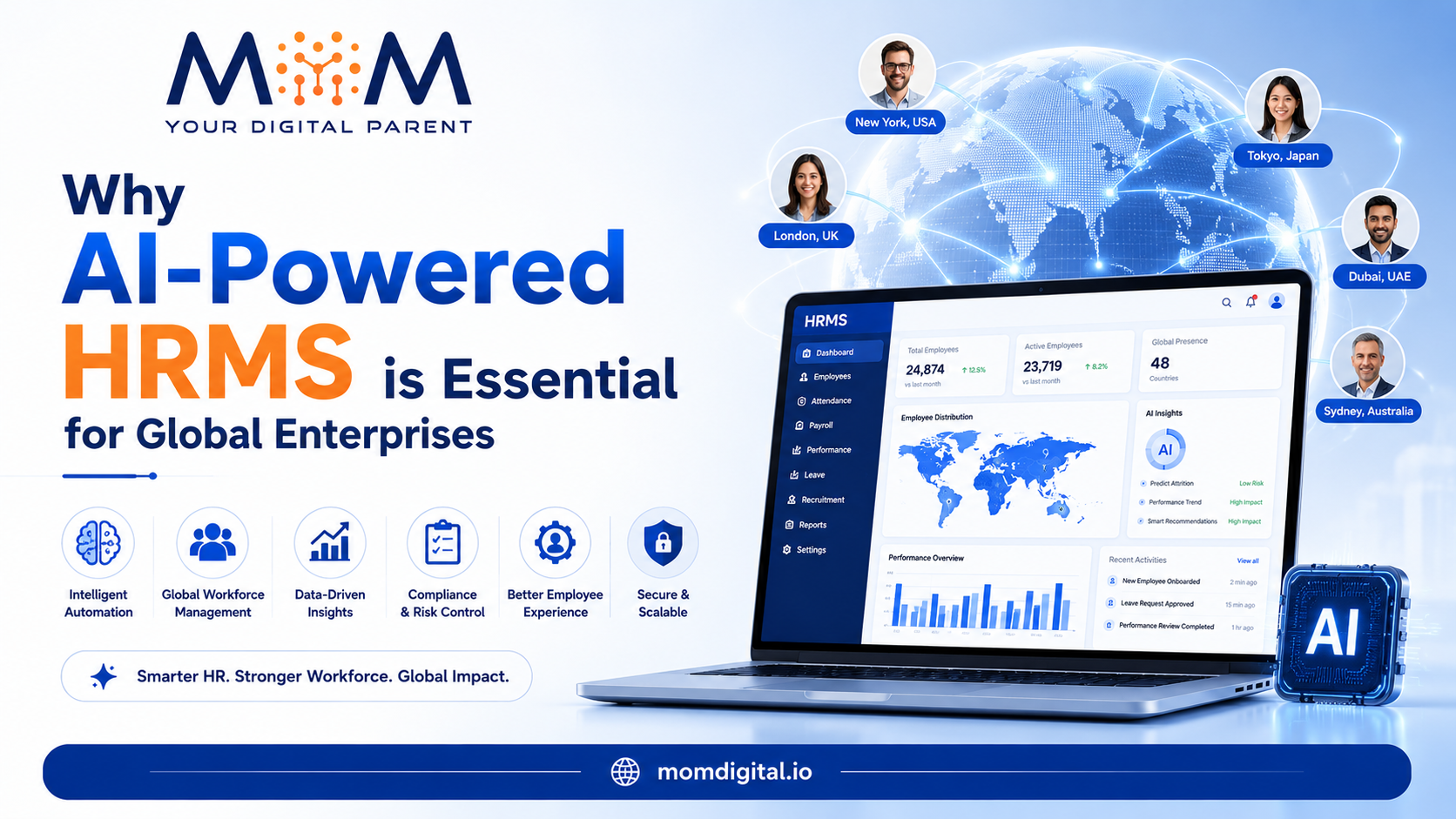
Managing a global workforce is no longer just about payroll and attendance. Modern enterprises operate across multiple countries, time zones, currencies, and labor regulations—making HR management more complex than ever before.
As organizations expand globally, traditional HR systems often struggle to keep up with increasing operational demands. Manual processes, disconnected tools, compliance risks, and inefficient workforce management create challenges that directly impact productivity and employee experience.
This is where AI-powered HRMS solutions are transforming the future of enterprise HR.
An intelligent Human Resources Management System (HRMS) helps businesses automate repetitive tasks, streamline workforce operations, improve decision-making, and deliver a better employee experience at scale.
At MOM Digital, businesses are adopting AI-driven HR technology to simplify global workforce management while improving efficiency, compliance, and operational visibility.
The Growing Challenges of Global Workforce Management
Global enterprises face HR challenges that are significantly more complex than those of smaller organizations.
Some of the most common challenges include:
- Managing employees across multiple countries
- Handling different labor laws and payroll regulations
- Tracking attendance and productivity across locations
- Maintaining consistent HR policies globally
- Reducing payroll errors and compliance risks
- Improving employee engagement in distributed teams
- Managing large volumes of HR data efficiently
Traditional HR systems often rely heavily on manual intervention, spreadsheets, and disconnected software. This not only slows down HR operations but also increases the chances of human error.
As businesses scale, these inefficiencies become costly.
AI-powered HRMS platforms solve these problems by creating a centralized, automated, and intelligent HR ecosystem.
What is an AI-Powered HRMS?
An AI-powered HRMS combines traditional HR management features with artificial intelligence and automation capabilities.
Instead of simply storing employee information, intelligent HRMS platforms actively help businesses optimize workforce management.
These systems can automate repetitive HR tasks, analyze workforce trends, generate insights, predict potential issues, and improve operational accuracy.
Modern AI-powered HRMS platforms typically include:
- Employee lifecycle management
- Attendance and leave management
- Payroll automation
- Recruitment and onboarding
- Performance management
- Employee self-service portals
- AI-based analytics and reporting
- Compliance monitoring
- Workflow automation
For global enterprises, AI becomes a strategic advantage rather than just a technology upgrade.
How AI-Powered HRMS Helps Global Enterprises
1. Automates Repetitive HR Operations
HR teams spend a significant amount of time on repetitive administrative tasks such as attendance tracking, leave approvals, payroll calculations, and document management.
AI-powered HRMS platforms automate these workflows, reducing manual work and improving efficiency.
Automation helps HR teams:
- Reduce processing time
- Minimize human errors
- Improve operational consistency
- Focus more on strategic HR initiatives
Instead of spending hours managing spreadsheets, HR professionals can concentrate on employee development, culture, and workforce planning.
2. Simplifies Multi-Country Payroll and Compliance
Payroll and compliance management become increasingly difficult when businesses operate in multiple countries.
Each country has different:
- Tax structures
- Labor laws
- Overtime regulations
- Leave policies
- Payroll requirements
AI-powered HRMS solutions help enterprises manage these complexities through intelligent automation and centralized compliance tracking.
This reduces compliance risks and ensures payroll accuracy across global operations.
Businesses using advanced HRMS platforms can significantly reduce payroll disputes, delays, and regulatory penalties.
3. Enhances Workforce Visibility with Real-Time Analytics
One of the biggest advantages of AI-powered HR systems is access to real-time workforce insights.
Instead of relying on outdated reports, enterprise leaders can make data-driven decisions using live dashboards and analytics.
AI-based reporting helps organizations monitor:
- Attendance trends
- Employee productivity
- Workforce costs
- Attrition patterns
- Overtime usage
- Department performance
- Hiring efficiency
These insights allow HR leaders to identify problems early and improve workforce planning.
For global enterprises, centralized analytics create better operational visibility across all locations.
4. Improves Employee Experience
Employee expectations have changed dramatically in recent years.
Modern employees expect seamless digital experiences similar to consumer apps. Slow HR processes and manual approvals negatively impact employee satisfaction.
AI-powered HRMS platforms improve employee experience through:
- Self-service portals
- Mobile access
- Faster approvals
- Automated communication
- Transparent leave tracking
- Simplified payroll access
- Digital onboarding
Employees can independently access HR information, reducing dependency on HR teams for routine tasks.
A better employee experience often leads to higher engagement and improved retention rates.
5. Supports Remote and Hybrid Workforces
Remote and hybrid work models are now standard for many global enterprises.
Managing distributed teams requires better workforce visibility and digital collaboration tools.
AI-powered HRMS solutions help businesses manage remote employees through:
- Cloud-based accessibility
- Mobile attendance tracking
- Geolocation check-ins
- Shift management
- Productivity monitoring
- Automated workflows
This ensures consistency across both in-office and remote teams.
Global enterprises can maintain operational control while offering employees greater flexibility.
6. Strengthens HR Decision-Making
AI is not just about automation — it also improves decision-making.
Advanced HRMS platforms analyze large volumes of workforce data and generate actionable insights.
AI can help HR leaders:
- Predict employee turnover risks
- Identify hiring gaps
- Improve workforce allocation
- Optimize scheduling
- Forecast staffing needs
- Detect attendance irregularities
Predictive analytics enables proactive HR management instead of reactive problem-solving.
For enterprises managing thousands of employees, this creates a major competitive advantage.
7. Scales Easily with Business Growth
As enterprises expand globally, HR complexity grows rapidly.
Traditional HR systems often struggle to scale efficiently.
AI-powered HRMS platforms are designed for scalability, allowing businesses to:
- Add new locations easily
- Manage larger workforces
- Standardize HR processes globally
- Integrate multiple departments
- Centralize workforce operations
This flexibility is essential for organizations planning long-term international growth.
Why Global Enterprises are Moving Toward AI-First HRMS Platforms
The future of HR is becoming increasingly AI-driven.
Global organizations are now prioritizing intelligent HR systems because they offer:
- Higher operational efficiency
- Better workforce visibility
- Faster HR processes
- Improved compliance management
- Reduced administrative costs
- Better employee engagement
- Stronger business scalability
AI-powered HRMS is no longer considered a luxury technology investment. It has become a business necessity for enterprises managing complex workforces.
Organizations that continue relying on outdated HR systems risk operational inefficiencies, compliance issues, and poor employee experiences.
How MOM Digital Helps Enterprises Modernize HR Operations
MOM Digital provides AI-powered HRMS solutions designed to help enterprises simplify workforce management and automate HR operations at scale.
From attendance and payroll automation to workforce analytics and employee management, MOM Digital enables businesses to create a more efficient, intelligent, and employee-focused HR ecosystem.
By combining automation, AI, and centralized workforce management, enterprises can reduce administrative overhead while improving operational performance across global teams.
Final Thoughts
Global workforce management is becoming more complex every year. Enterprises need smarter systems that can adapt to changing business demands, remote work environments, and international compliance requirements.
AI-powered HRMS platforms help organizations automate operations, improve employee experiences, strengthen compliance, and make better workforce decisions.
For modern global enterprises, adopting an intelligent HRMS is no longer optional — it is essential for sustainable growth and operational efficiency.
Businesses investing in AI-driven HR technology today will be better positioned to build agile, scalable, and future-ready workforces tomorrow.
Ответственная игра — это стиль поведения, при которой игры являются способом отдыха, а не средством поправить финансовое положение.
Она базируется на контроле длительностью и бюджетом, а также на осознании личных границ.
https://rosotels.ru/detail/2026-07-09-kak-pogasit-kredit-bystro-prakticheskie-rekomendatsii.htm
Осознанный подход к гемблингу — это выбор, при котором игры служат способом досуга, а не стремлением заработать.
Такой подход строится на контроле временем и бюджетом, а также на осознании своих пределов.
https://eurasia-log.ru/blog/2026-07-14-ukhod-za-krossovkami-dolce-andamp-gabbana-kak-sokhranit-vneshniy-vid-i-prodlit-srok-sluzhby/
Здесь ресурсе можно отыскать много полезной информации.
https://wolgograd.ru/column/2950-krossovki-v-krossfite-luchshie-modeli-dlya-trenirovok/
На данном ресурсе вы сможете найти много нужной сведений.
https://dvery35.ru/article/4619-trendy-2024-goda-kakie-krossovki-budut-v-mode.html
Здесь портале вы сможете обнаружить много нужной информации.
https://allods.my.games/forum/index.php?page=User&userID=251986
Internet adventures provide participants a great avenue to socialize and have fun with gamers globally.
https://b3.hypebeasts.ru/3TzxeG3aGgEY/
Здесь сайте есть шанс найти важную информацию.
https://bnavigator.ru/publication/2026-07-14-iranskaya-kartina-zakhvatila-gran-pri-festivalya-v-krugu-semi-v-yaroslavle.html
На этом ресурсе удастся обнаружить полезную информацию.
https://fsfr-vkr.ru/read-full/1264-budushchee-igrovykh-slotov-prognozy-i-trendy-na-blizhayshie-gody.html
Здесь портале удастся почерпнуть важную информацию.
https://wolgograd.ru/column/2702-the-history-and-evolution-of-beepbeep-casino/
На этом портале вы сможете получить важную информацию.
https://nanmed.ru/read/4089-polnyy-obzor-igrovykh-avtomatov-v-randx-casino/
На этом сайте удастся почерпнуть интересную информацию.
https://relax-spb.ru/read-info/3095-kaluzhskaya-karatistka-vzyala-serebro-v-spartakiade-uchashchikhsya-rossii-final-xiii-letnego-turnira.html
Здесь сайте удастся обнаружить важную информацию.
https://chenews.ru/
На этом сайте удастся найти важную информацию.
https://relax-spb.ru/read-info/3515-novorossiysk-prekrashchenie-vydachi-toplivnykh-talonov-i-zakrytie-onlayn-zapisi-na-azs.html
Здесь сайте вы сможете отыскать полезную информацию.
https://b1.hypebeasts.ru/GNncN5yF0zvJ/
На данном портале есть шанс отыскать интересную информацию.
https://e-transavto.ru/read/tragicheskiy-final-poiskov-rybaka-na-ozere-busse-telo-naydeno-spustya-sem-dney-484/
Тут ресурсе есть шанс найти интересную информацию.
https://science.meatmoda.ru/gaJ7ozh77zBe/
На данном ресурсе есть шанс обнаружить полезную информацию.
https://techguru.podium24.ru/YkZECqgATK6B/
Здесь веб-сайте удастся почерпнуть ценную информацию.
https://nanmed.ru/read/2473-taksist-v-pattaye-popytalsya-proniknut-v-nomer-gostinitsy-ostaviv-devushku-s-psikhicheskoy-travmoy/
На данном ресурсе удастся отыскать важную информацию.
https://protivbed.ru/full-article/mobile-gaming-experience-at-beepbeep-casino-features-compatibility-and-tips-2045/
Свадьба становится значимым событием в жизни людей.
Этот день знаменует начало совместной семьи.
Он соединяет этих любящих партнёров перед родными и гостями.
http://gubernya63.ru/novosti-partnerov/ferragosto-nacionalnyj-italjanskij-prazdnik.html
Церемония даёт молодым открыто признаться в любви и дать обещания.
Свадьба становится воспоминанием на долгие годы, поддерживая связь супругов.
На представленном онлайн-ресурсе удастся отыскать много полезной информации.
https://shambhala-center.ru/info-bulletin/2026-06-19-narodnyy-kontrol-proveril-situatsiyu-v-korablino-ryazanskaya-oblast.htm