
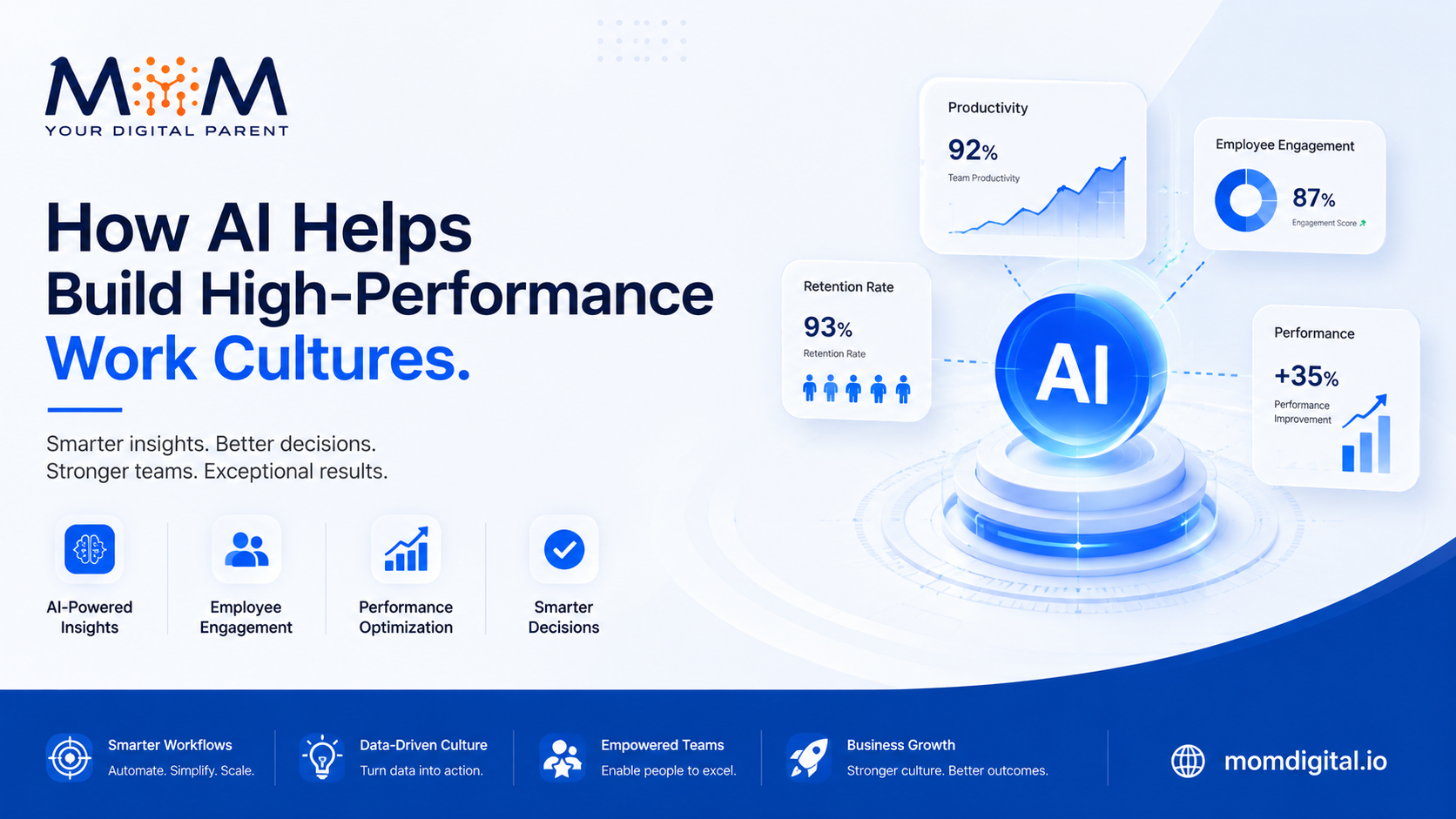
In today’s competitive business environment, organizations are constantly looking for ways to improve productivity, retain talent, and build stronger workplace cultures. A high-performance work culture is no longer created through policies alone, it is shaped by data, technology, leadership, and employee experience.
Artificial Intelligence (AI) is now playing a powerful role in transforming how organizations manage their people and performance. When integrated into HR systems, AI helps companies move beyond traditional management practices and build intelligent, high-performance workplaces.
This shift is not just about automation—it is about creating a culture where decisions are smarter, employees are more engaged, and performance is continuously improved.
Understanding a High-Performance Work Culture
A high-performance work culture is one where employees are motivated, aligned with organizational goals, and consistently performing at their best.
Such a culture is built on:
- Clear communication
- Transparent performance tracking
- Continuous feedback
- Employee engagement
- Data-driven decision-making
However, achieving this manually is difficult. Traditional HR methods often lack real-time insights and consistency, making it hard to maintain high performance across teams.
This is where AI-powered HR systems bring a major transformation.
The Role of AI in Modern HR Systems
AI in HR is not just about automation. It is about intelligence—understanding patterns, predicting outcomes, and supporting better decisions.
When AI is integrated into HRMS platforms, it can analyze workforce data, identify trends, and provide actionable insights that help organizations build stronger teams.
Instead of relying on assumptions, HR leaders can make decisions based on real-time data and predictive analytics.
Improving Employee Performance with AI
One of the most significant contributions of AI is its ability to improve employee performance.
AI systems can continuously track performance metrics such as:
- Task completion rates
- Productivity levels
- Attendance patterns
- Engagement levels
By analyzing this data, AI can identify high performers as well as employees who may need additional support or training.
This allows managers to take timely action and ensure that every employee is performing at their best.
Personalized Employee Development
Every employee has different strengths, weaknesses, and learning needs. AI helps organizations personalize employee development programs.
Instead of offering generic training, AI-powered HR systems can:
- Recommend skill development programs
- Identify learning gaps
- Suggest career growth paths
- Track training effectiveness
This personalized approach improves employee satisfaction and helps individuals grow within the organization.
When employees see a clear development path, they are more motivated and engaged.
Enhancing Employee Engagement
Employee engagement is a key factor in building a high-performance culture. AI helps organizations understand how employees feel and what motivates them.
Through sentiment analysis and behavioral data, AI can detect:
- Employee satisfaction levels
- Engagement trends
- Potential burnout risks
This allows HR teams to take proactive steps such as improving communication, adjusting workloads, or introducing wellness initiatives.
When employees feel heard and supported, engagement naturally increases.
Smarter Performance Management
Traditional performance reviews are often limited to periodic evaluations. AI changes this by enabling continuous performance management.
AI-powered HR systems provide real-time insights into employee performance, allowing managers to:
- Set measurable goals
- Track progress continuously
- Provide timely feedback
- Identify performance gaps
This creates a culture of continuous improvement rather than annual evaluation.
Employees receive ongoing support, which helps them perform better throughout the year.
Data-Driven Decision-Making
High-performance cultures are built on informed decisions, not guesswork.
AI helps HR leaders and managers make better decisions by analyzing workforce data such as:
- Productivity trends
- Employee turnover rates
- Skill gaps
- Team performance comparisons
With this information, organizations can optimize workforce planning, allocate resources effectively, and improve overall efficiency.
Data-driven HR management leads to stronger organizational outcomes.
Reducing Bias in HR Processes
One of the challenges in traditional HR systems is unconscious bias in hiring, promotions, and evaluations.
AI helps reduce bias by relying on data-driven insights rather than subjective judgment.
For example, AI can:
- Evaluate candidates based on skills and qualifications
- Standardize performance assessments
- Ensure fair talent evaluation processes
This promotes fairness and equality within the organization, strengthening workplace culture.
Supporting Employee Wellbeing
Employee wellbeing is an essential part of a high-performance culture. Overworked or stressed employees cannot perform at their best.
AI helps organizations monitor workload patterns and detect early signs of burnout.
It can identify:
- Excessive working hours
- Declining productivity
- Engagement drop
- Absenteeism patterns
With these insights, HR teams can take corrective actions to support employee wellbeing and maintain balance.
Improving Communication and Collaboration
AI-powered HR systems improve communication within organizations by providing better visibility into workflows and team performance.
Employees and managers can:
- Access real-time updates
- Track project progress
- Communicate more effectively
This reduces confusion, improves coordination, and strengthens teamwork.
Better communication leads to stronger collaboration and higher productivity.
Building a Culture of Accountability
AI encourages accountability by making performance and attendance data transparent and measurable.
When employees know that their work is being tracked fairly and consistently, they are more likely to stay responsible and focused.
This creates a culture where everyone understands their role and contribution toward organizational goals.
Enhancing Recruitment for Better Culture Fit
A high-performance culture starts with hiring the right people. AI improves recruitment by identifying candidates who are not only skilled but also aligned with company values.
AI can:
- Screen resumes efficiently
- Match candidates with job roles
- Analyze cultural fit
- Predict hiring success
This ensures that new employees contribute positively to the organization from day one.
The Long-Term Impact of AI on Workplace Culture
The impact of AI on workplace culture is long-lasting. Over time, organizations experience:
- Higher employee engagement
- Improved productivity
- Better talent retention
- Stronger leadership decisions
- More efficient operations
AI transforms HR from a support function into a strategic driver of culture and performance.
Conclusion
Building a high-performance work culture requires more than policies and management—it requires intelligence, insight, and continuous improvement.
AI-powered HR systems help organizations achieve this by improving performance tracking, enhancing employee engagement, reducing bias, and enabling data-driven decision-making.
By integrating intelligence into everyday HR processes, businesses can create a workplace where employees are motivated, supported, and empowered to perform at their best.
With advanced AI-driven HRMS solutions designed for modern organizations, MOM Digital helps businesses build high-performance work cultures that are smarter, more efficient, and ready for the future of work.