
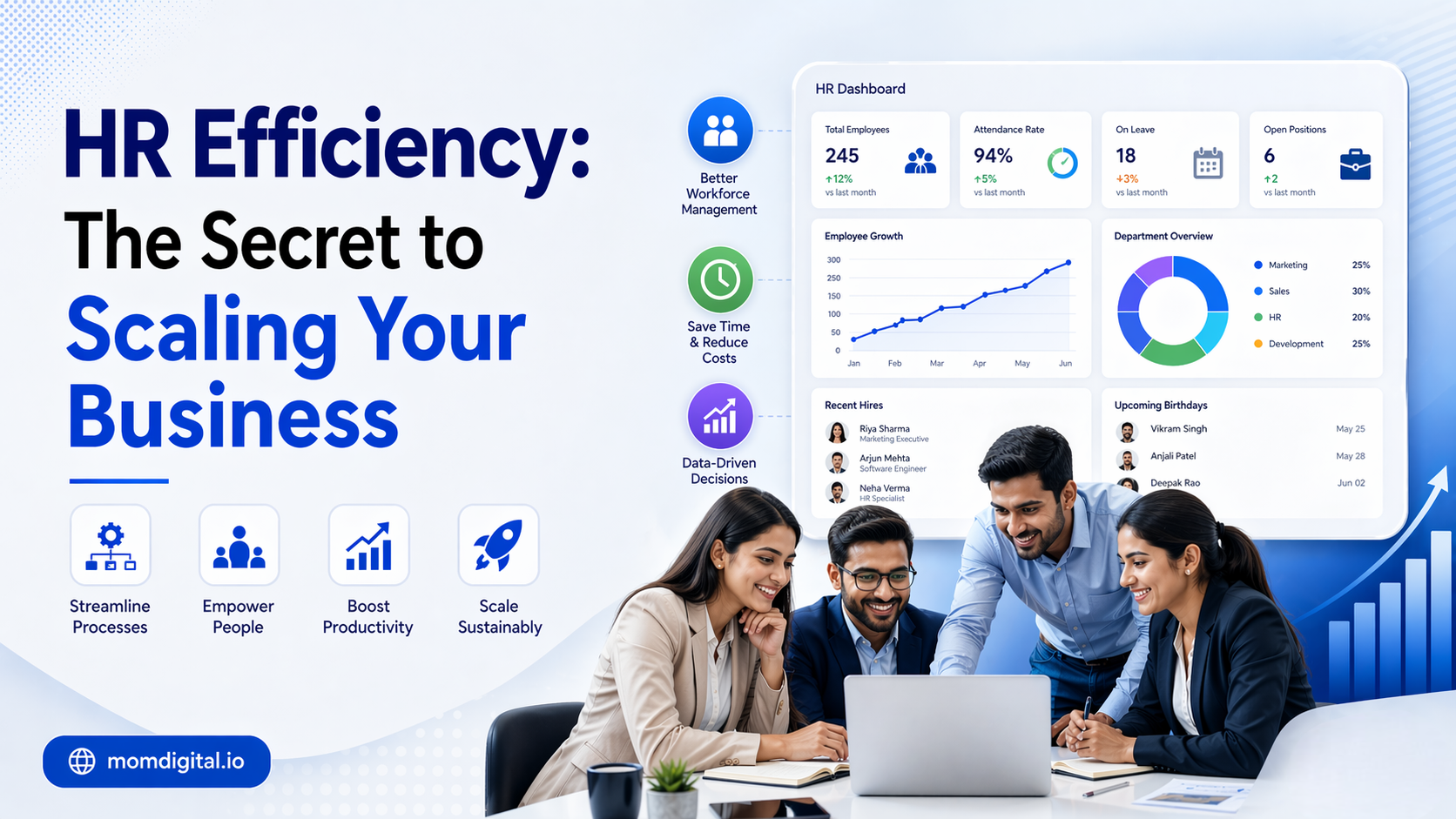
Scaling a business is an exciting milestone—but it also brings new challenges. As companies grow, operations become more complex, teams expand, and managing employees becomes increasingly demanding.
While many businesses focus on sales, marketing, and product development as drivers of growth, one critical factor is often overlooked: HR efficiency.
Efficient HR processes are the backbone of a scalable organization. Without streamlined HR operations, businesses can face delays, errors, and inefficiencies that slow down growth. This is why modern organizations are investing in systems and strategies that improve HR efficiency.
What is HR efficiency?
HR efficiency refers to how effectively an organization manages its human resources with minimal time, effort, and cost while maximizing productivity and outcomes.
An efficient HR function ensures that processes such as payroll, attendance, recruitment, and employee management are handled smoothly and accurately.
Instead of being burdened by administrative tasks, HR teams can focus on strategic initiatives that contribute to business growth.
Why HR Efficiency Matters for Scaling
As businesses grow, the number of employees, processes, and responsibilities increases. Without efficient systems in place, HR teams can quickly become overwhelmed.
Inefficient HR processes can lead to:
- Delayed hiring and onboarding
- Payroll errors and employee dissatisfaction
- Poor communication across teams
- Lack of workforce visibility
- Increased operational costs
These issues not only affect productivity but also hinder the company’s ability to scale effectively.
HR efficiency ensures that as your business grows, your operations remain smooth and manageable.
Automating Repetitive HR Tasks
One of the most effective ways to improve HR efficiency is through automation.
Manual tasks such as payroll processing, attendance tracking, and leave management consume valuable time and are prone to errors.
Automation allows businesses to:
- Process payroll quickly and accurately
- Track attendance in real time
- Manage leave requests seamlessly
- Maintain organized employee records
By reducing manual work, HR teams can focus on more important tasks such as talent development and employee engagement.
Streamlining Recruitment for Faster Growth
Hiring the right talent at the right time is essential for scaling a business. However, inefficient recruitment processes can slow down growth.
HR efficiency improves recruitment by:
- Centralizing candidate applications
- Tracking hiring progress
- Automating interview scheduling
- Reducing time-to-hire
A streamlined recruitment process ensures that businesses can quickly fill positions and maintain momentum.
Faster hiring means teams can expand without delays, supporting business growth.
Enhancing Employee Experience
Employee experience plays a crucial role in productivity and retention. Efficient HR processes contribute to a positive work environment by reducing frustration and improving communication.
Modern HR systems provide features such as:
- Employee self-service portals
- Transparent payroll and attendance tracking
- Easy access to company policies
When employees can access information quickly and manage their own tasks, they feel more empowered and engaged.
Engaged employees are more productive and contribute more effectively to business success.
Improving Accuracy and Reducing Errors
Errors in HR processes, especially in payroll and attendance, can have serious consequences.
Inefficient systems increase the risk of:
- Incorrect salary calculations
- Mismanaged leave records
- Compliance issues
HR efficiency ensures that processes are standardized and accurate.
Automated systems reduce human error, ensuring that employees are paid correctly and records are maintained properly.
This builds trust within the organization and avoids unnecessary complications.
Leveraging Data for Better Decision-Making
Data is a powerful tool for scaling businesses. Efficient HR systems provide real-time insights into workforce performance and operations.
Organizations can analyze:
- Employee productivity trends
- Attendance patterns
- Recruitment performance
- Workforce costs
These insights help business leaders make informed decisions about hiring, resource allocation, and workforce planning.
Data-driven decision-making allows businesses to scale strategically rather than reactively.
Supporting Scalability and Flexibility
As businesses grow, they need systems that can adapt to increasing demands.
HR efficiency ensures scalability by:
- Managing larger teams without increasing workload
- Supporting multiple departments and locations
- Adapting to new business requirements
Flexible HR systems allow organizations to expand without disrupting operations.
This adaptability is essential for long-term growth.
Reducing Operational Costs
Inefficient HR processes often result in hidden costs such as:
- Time spent on manual tasks
- Costs of correcting errors
- Delays in hiring
- Compliance penalties
Improving HR efficiency reduces these costs by streamlining processes and minimizing errors.
Businesses can then allocate resources to growth initiatives instead of administrative overhead.
The Role of HR Technology in Efficiency
Technology plays a crucial role in improving HR efficiency. Modern HRMS platforms integrate all HR functions into a single system, providing automation, real-time insights, and seamless workflows.
With the right HR technology, businesses can:
- Centralize employee data
- Automate routine tasks
- Improve communication
- Enhance decision-making
HRMS acts as the foundation for efficient HR operations and scalable business growth.
Building a Culture of Efficiency
While technology is important, HR efficiency also depends on organizational culture.
Businesses should:
- Encourage process improvement
- Train employees on new systems
- Promote transparency and communication
- Continuously evaluate HR practices
A culture that values efficiency ensures that systems and processes are used effectively.
Conclusion
Scaling a business requires more than just increasing revenue—it requires building strong, efficient systems that support growth.
HR efficiency is a critical factor in this process. By automating tasks, improving accuracy, enhancing employee experience, and leveraging data, businesses can create a strong foundation for expansion.
Without efficient HR operations, growth can become chaotic and difficult to manage. With the right systems in place, scaling becomes smoother and more sustainable.
By providing advanced HRMS solutions designed to streamline processes and improve workforce management, MOM Digital helps businesses achieve HR efficiency and unlock their full growth potential in today’s competitive landscape.