
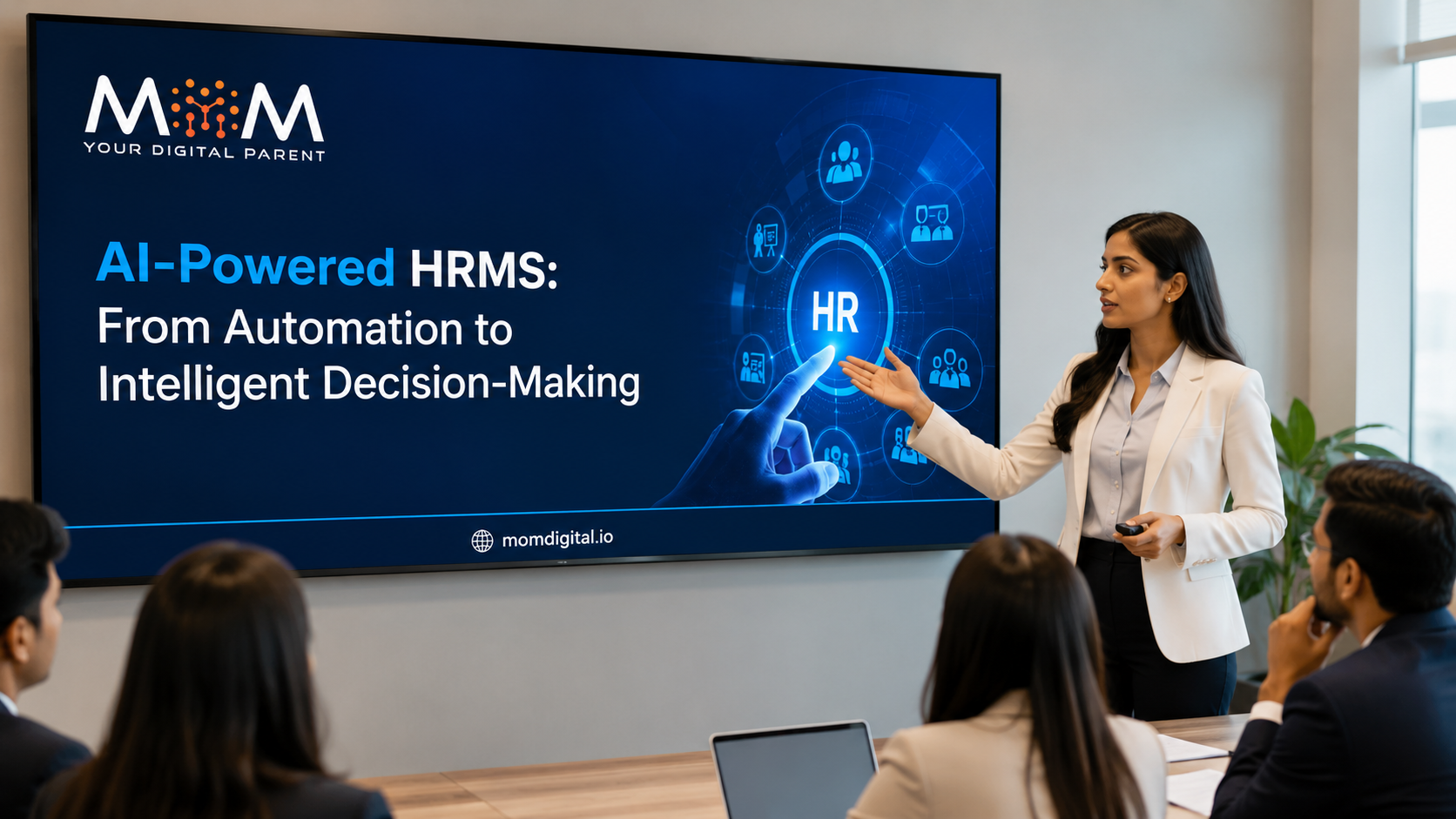
Human Resource Management has evolved far beyond manual record-keeping and administrative tasks. In today’s fast-changing business environment, HR is expected to be faster, smarter, and more strategic than ever before.
Traditional HR systems mainly focused on digitizing paperwork and automating routine processes. But modern organizations need more than automation—they need intelligence.
This is where AI-powered HRMS (Human Resource Management System) transforms the entire HR landscape. It goes beyond simple automation and helps businesses move toward intelligent decision-making, predictive insights, and smarter workforce management.
The Evolution of HRMS: From Manual to Intelligent Systems
Earlier HR systems were designed to reduce paperwork. Then came digital HRMS platforms that automated payroll, attendance, and employee records.
Now, with the integration of Artificial Intelligence, HRMS has entered a new era—one where systems not only process data but also analyze, predict, and guide decisions.
AI-powered HRMS is not just a tool; it is a strategic partner for HR teams.
What Makes AI-Powered HRMS Different?
Unlike traditional HR software, AI-powered HRMS uses machine learning and data analytics to understand patterns and generate insights.
It can:
- Predict employee turnover risks
- Recommend hiring decisions
- Analyze performance trends
- Automate complex HR workflows
- Provide intelligent workforce insights
This transforms HR from a reactive function into a proactive and strategic one.
Automation: The Foundation of Efficiency
At the core of AI-powered HRMS lies automation. It removes repetitive manual tasks and improves operational efficiency across all HR functions.
Key automated processes include:
- Payroll calculation
- Attendance tracking
- Leave approvals
- Recruitment workflows
- Employee data management
Automation ensures accuracy, saves time, and reduces administrative workload.
For HR teams, this means less time spent on routine tasks and more time focused on strategic initiatives.
Intelligent Recruitment and Hiring
Recruitment is one of the most time-consuming HR functions. AI-powered HRMS makes it faster and smarter.
It can automatically:
- Generate optimized job descriptions
- Screen resumes based on job requirements
- Rank candidates based on suitability
- Track application progress
- Suggest best-fit candidates
This reduces hiring time and improves the quality of recruitment decisions.
Businesses can build stronger teams faster, supporting overall growth and scalability.
Smarter Workforce Analytics
One of the most powerful features of AI-powered HRMS is its ability to turn raw data into meaningful insights.
Instead of just storing information, the system analyzes:
- Employee performance patterns
- Attendance behavior
- Productivity trends
- Attrition risks
These insights help HR leaders make informed decisions about workforce planning, promotions, and training needs.
Data-driven HR management leads to better organizational outcomes.
Predictive Decision-Making in HR
AI introduces predictive capabilities into HR systems. This means businesses can anticipate challenges before they occur.
For example, AI can:
- Predict employee turnover risk
- Identify skill gaps in teams
- Forecast hiring needs
- Suggest workload adjustments
This allows HR teams to take proactive steps instead of reacting to problems after they arise.
Predictive intelligence helps organizations stay ahead of workforce challenges.
Enhancing Employee Experience with AI
Employee experience plays a major role in productivity and retention. AI-powered HRMS improves this experience in several ways.
It provides:
- Instant access to HR services
- Personalized recommendations
- Faster query resolution
- Transparent HR processes
Employees feel more empowered when they can access information easily and receive personalized support.
A better employee experience leads to higher engagement and satisfaction.
Improving Accuracy and Compliance
Manual HR processes often lead to errors in payroll, attendance, and compliance reporting. AI-powered HRMS significantly reduces these risks.
It ensures:
- Accurate salary calculations
- Automated tax and compliance updates
- Error-free record management
- Real-time validation of data
This improves reliability and reduces the risk of penalties or disputes.
Supporting Remote Workforces
The modern workplace is no longer limited to a physical office. Remote work models are now standard across many industries.
AI-powered HRMS supports this shift by enabling:
- Remote attendance tracking
- Cloud-based HR access
- Digital onboarding processes
- Real-time communication tools
This flexibility ensures smooth operations regardless of employee location.
Driving Strategic HR Transformation
AI-powered HRMS transforms HR from an administrative department into a strategic business function.
Instead of focusing only on tasks, HR teams can now focus on:
- Talent development
- Workforce planning
- Employee engagement
- Organizational growth
This shift increases the overall value HR brings to the business.
Reducing Operational Costs
While AI-powered systems involve initial investment, they significantly reduce long-term operational costs.
Businesses benefit from:
- Reduced manual labor
- Fewer payroll errors
- Faster hiring cycles
- Improved resource allocation
Efficiency gains translate into cost savings and better ROI.
Building a Future-Ready HR System
AI-powered HRMS is not just a current solution—it is a future-ready platform designed for evolving business needs.
As organizations grow, the system adapts by:
- Scaling operations easily
- Integrating with new tools
- Updating processes automatically
- Improving decision-making capabilities
This ensures long-term sustainability and competitiveness.
The Strategic Advantage of AI in HR
Organizations that adopt AI-powered HRMS gain a clear competitive advantage.
They can:
- Make faster decisions
- Improve workforce efficiency
- Reduce operational risks
- Enhance employee satisfaction
- Scale more effectively
AI transforms HR into a data-driven, intelligent ecosystem.
Conclusion
AI-powered HRMS represents the next stage in the evolution of human resource management. It goes far beyond automation by introducing intelligence, prediction, and strategic insights into everyday HR operations.
From recruitment and payroll to performance management and workforce analytics, AI enables organizations to operate smarter and more efficiently.
By combining automation with intelligent decision-making, businesses can create a more agile, productive, and future-ready workplace.
With advanced AI-driven HRMS solutions designed for modern organizations, MOM Digital helps businesses move from manual processes to intelligent HR systems that support scalable growth, better decisions, and long-term success.