Managing a global workforce is no longer simple. Companies operating across multiple countries deal with different labor laws, time zones, payroll regulations, and hiring challenges. When payroll, attendance, and recruitment are handled through separate systems—or worse, manually—inefficiencies grow quickly.
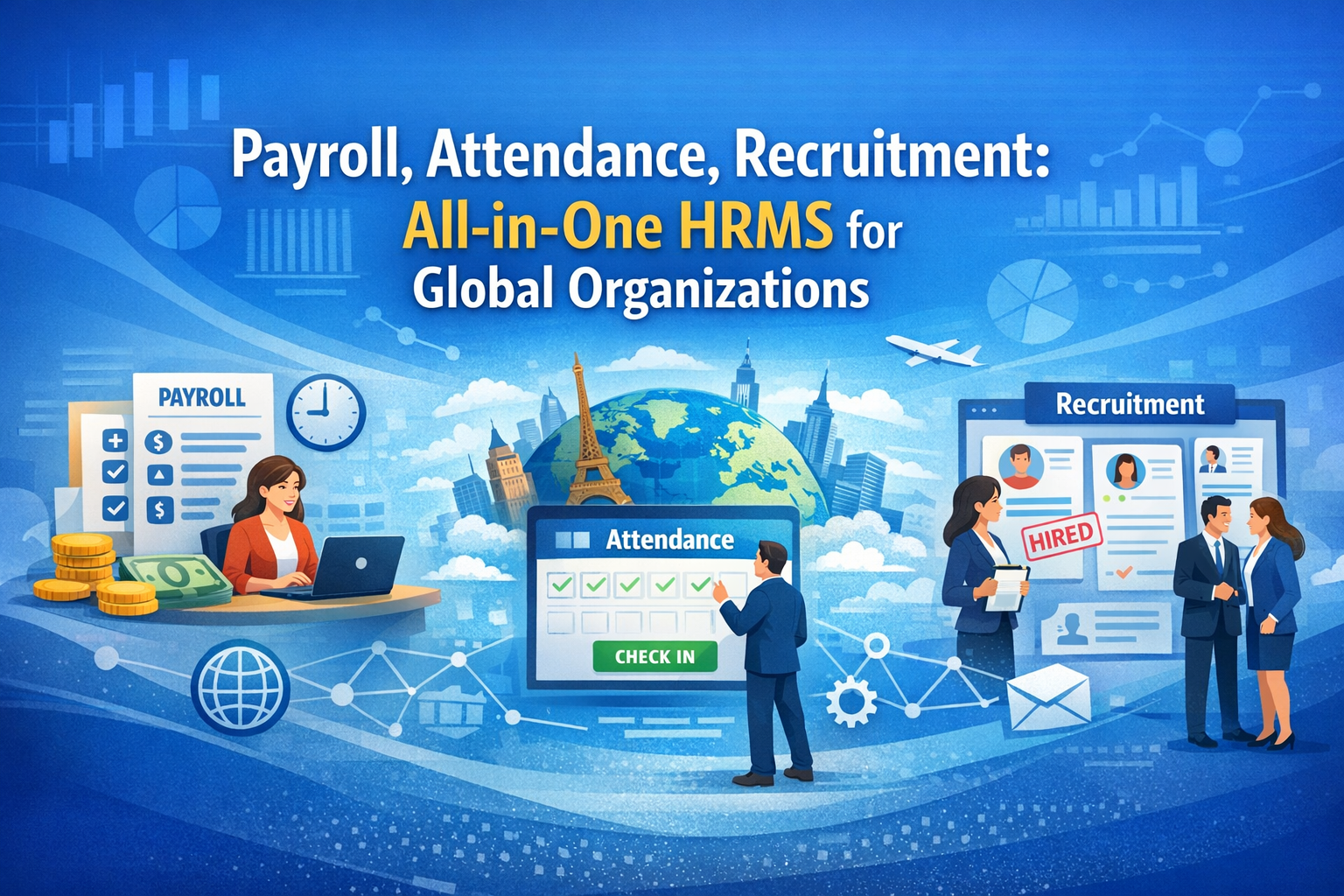
That’s why global organizations are shifting toward an all-in-one HRMS (Human Resource Management System). A unified platform that connects payroll, attendance, and recruitment creates a streamlined, accurate, and scalable HR environment.
Let’s explore how an integrated HRMS transforms workforce management for global businesses.
The Challenge of Managing a Global Workforce
Operating in multiple countries brings unique HR complexities:
- Different tax structures and compliance rules
- Multi-currency payroll processing
- Varied working hours and shift policies
- Cross-border hiring requirements
- Diverse employee documentation standards
When these processes are disconnected, errors and delays become common. An all-in-one HRMS centralizes operations, giving organizations better control and visibility across regions.
Unified Payroll Management Across Borders
Payroll is one of the most critical HR functions. In global organizations, payroll becomes even more complex due to:
- Currency differences
- Country-specific tax regulations
- Statutory deductions
- Overtime rules
- Benefits management
An all-in-one HRMS automates payroll calculations by integrating attendance data, leave records, and compensation structures into a single system.
Key Benefits of Integrated Payroll:
- Accurate salary calculations
- Automated tax and compliance management
- Multi-country payroll processing
- Reduced manual errors
- Timely salary disbursement
When payroll is automated and centralized, finance and HR teams spend less time correcting mistakes and more time focusing on strategic planning.
Smart Attendance Management for Global Teams
Tracking attendance across different time zones and locations can be challenging. Remote teams, hybrid work models, and shift-based operations require flexible systems.
An all-in-one HRMS provides:
- Real-time attendance tracking
- Face scanning—check-in options
- Shift scheduling and rotation management
- Overtime monitoring
- Leave tracking integration
Managers gain visibility into workforce availability instantly. This helps with better resource allocation, improved scheduling, and reduced absenteeism.
When attendance data connects directly to payroll, salary calculations become faster and more accurate—eliminating duplication and data inconsistencies.
Streamlined Recruitment for International Hiring
Recruiting across countries involves multiple steps—sourcing candidates, tracking interviews, collecting documents, and ensuring compliance with local employment laws.
A unified HRMS simplifies recruitment by offering:
- Centralized candidate database
- Automated job postings
- Interview tracking workflows
- Offer letter management
- Digital onboarding processes
Recruiters can monitor every stage of hiring from a single dashboard. Once a candidate is selected, onboarding workflows automatically transfer employee data into payroll and attendance modules.
This seamless transition reduces administrative delays and allows new hires to become productive quickly.
One System, Complete Workforce Visibility
When payroll, attendance, and recruitment operate independently, decision-makers lack real-time insights. An all-in-one HRMS consolidates all workforce data into unified dashboards.
Leaders can analyze:
- Hiring trends
- Payroll costs by region
- Overtime patterns
- Employee turnover rates
- Attendance performance
This data-driven approach enables strategic workforce planning and smarter budgeting decisions.
Instead of reacting to issues, organizations can anticipate challenges and act proactively.
Compliance and Risk Management
Global organizations must comply with various labor laws and reporting standards. Missing deadlines or miscalculating statutory payments can result in penalties.
An integrated HRMS supports compliance by:
- Maintaining updated regulatory frameworks
- Generating statutory reports
- Tracking contract renewals
- Storing employee documentation securely
Automation reduces compliance risks and ensures that HR operations remain legally sound across regions.
Enhanced Employee Experience
Employee experience directly impacts productivity and retention. Modern HRMS platforms often include self-service portals where employees can:
- View payslips
- Apply for leave
- Update personal information
- Track attendance records
- Access company policies
This transparency builds trust and reduces dependency on HR teams for routine requests.
When employees have easy access to their information, engagement improves — and so does performance.
Supporting Remote Work Models
Global organizations increasingly operate with distributed teams. An all-in-one HRMS provides cloud-based access, enabling HR teams and employees to manage tasks from anywhere.
Features such as digital document signing, remote attendance tracking, and online onboarding ensure smooth operations regardless of location.
This flexibility supports business continuity while maintaining operational efficiency.
Cost Efficiency Through Integration
Using separate systems for payroll, attendance, and recruitment increases costs — including software subscriptions, maintenance fees, and integration complexities.
An all-in-one HRMS reduces:
- Software redundancy
- Data duplication
- Administrative overhead
- Manual correction costs
Centralization leads to operational savings and better ROI on HR technology investments.
The Strategic Advantage of an All-in-One HRMS
Payroll ensures employees are paid accurately. Attendance ensures workforce accountability. Recruitment ensures the right talent joins the organization.
When these three core HR functions operate within a single ecosystem, organizations experience:
- Faster processing
- Higher accuracy
- Improved workforce visibility
- Better compliance control
- Stronger employee engagement
An all-in-one HRMS transforms HR from a transactional department into a strategic driver of business growth.
Conclusion
Managing payroll, attendance, and recruitment separately may have worked in the past—but global organizations today require integration, automation, and real-time insights.
An all-in-one HRMS simplifies complex operations, enhances accuracy, improves compliance, and strengthens workforce management across regions.
For organizations seeking a reliable, scalable, and globally adaptable HR solution, MOM Digital delivers a comprehensive platform designed to unify payroll, attendance, and recruitment into one seamless system—empowering businesses to operate smarter, faster, and more efficiently worldwide.