
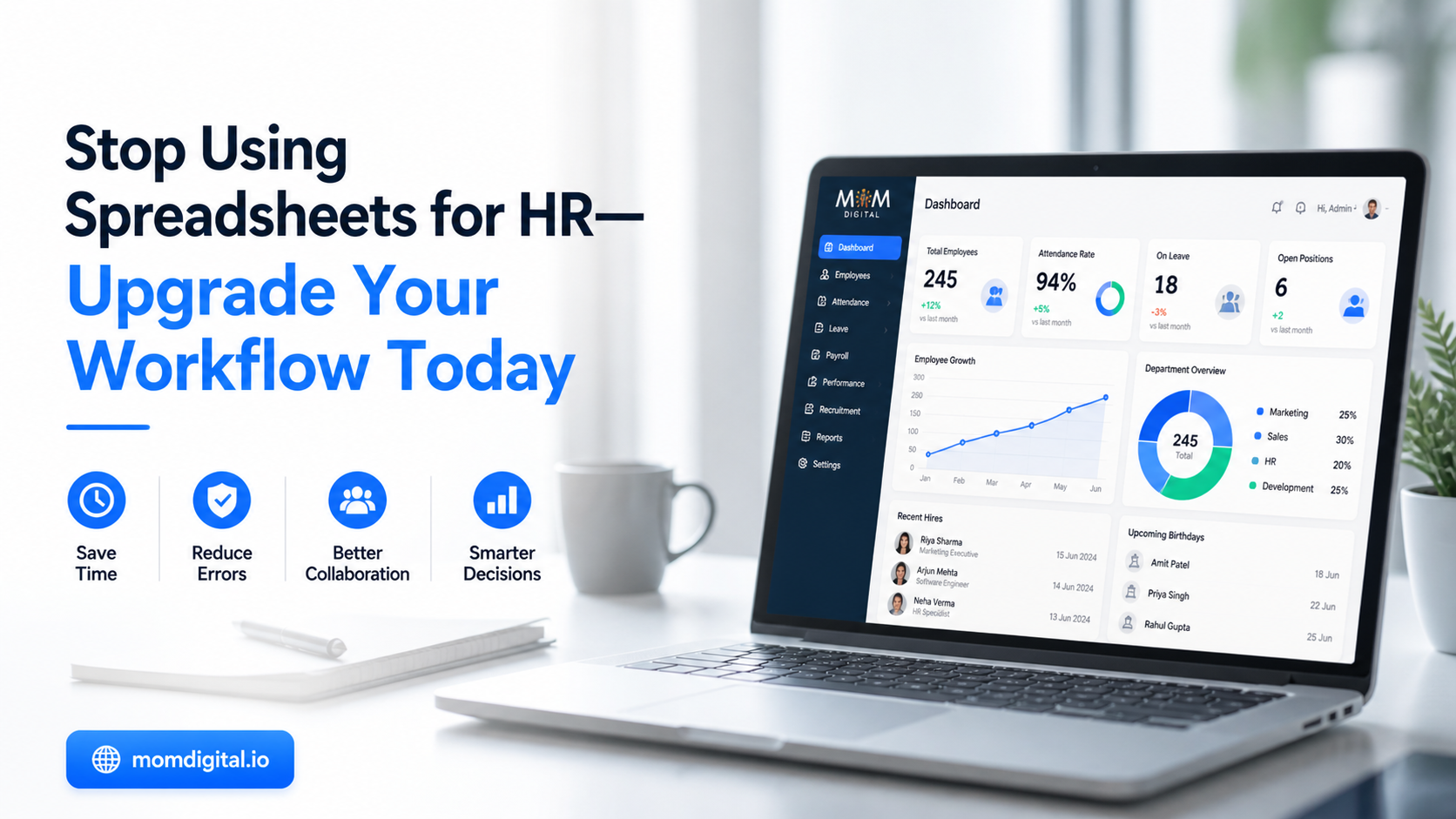
For many small and growing businesses, spreadsheets have long been the go-to tool for managing HR tasks. From tracking employee attendance and calculating payroll to maintaining records and handling recruitment data, spreadsheets seem simple, familiar, and cost-effective.
But as your business grows, what once felt like a convenient solution quickly becomes a major limitation.
If your HR team is still relying on spreadsheets, it’s time to ask an important question: Is your current system helping your business grow—or holding it back?
Let’s explore why spreadsheets are no longer enough for modern HR management and how upgrading your workflow can transform your business operations.
The Problem with Spreadsheet-Based HR
Spreadsheets may work for very small teams, but they are not designed for complex, dynamic HR processes. As your workforce expands, managing HR through spreadsheets becomes inefficient and risky.
Here are some of the most common challenges:
1. High Risk of Errors
Manual data entry increases the chances of mistakes in payroll calculations, attendance tracking, and employee records. Even a small error can lead to salary issues or compliance problems.
2. Time-Consuming Processes
Updating spreadsheets, cross-checking data, and maintaining multiple files takes a significant amount of time. HR teams often spend hours on repetitive tasks instead of focusing on strategic work.
3. Lack of Real-Time Data
Spreadsheets do not provide real-time insights. By the time reports are updated, the data may already be outdated, leading to delayed decisions.
4. Data Duplication and Confusion
Managing multiple spreadsheets for payroll, attendance, and employee records often results in duplicated data and version control issues.
5. Limited Scalability
As your organization grows, spreadsheets become increasingly difficult to manage. Adding more employees, departments, or locations only increases complexity.
Why Modern Businesses Need More Than Spreadsheets
Today’s workplace demands speed, accuracy, and flexibility. HR is no longer just about record-keeping—it’s about driving productivity, improving employee experience, and supporting business growth.
To meet these demands, businesses need systems that can:
- Automate repetitive tasks
- Provide real-time insights
- Ensure data accuracy
- Scale with growth
- Improve collaboration
Spreadsheets simply cannot deliver these capabilities.
Upgrade to a Smarter HR Workflow
Upgrading your HR workflow means moving from manual processes to a modern HRMS (Human Resource Management System). An HRMS integrates all HR functions into a single platform, making it easier to manage employees and streamline operations.
How HRMS Transforms Your HR Workflow
1. Automation of Routine Tasks
An HRMS eliminates manual work by automating key processes such as payroll, attendance tracking, and leave management.
Instead of spending hours on calculations and data entry, HR teams can rely on automated systems that ensure speed and accuracy.
2. Centralized Data Management
With HRMS, all employee information is stored in one secure location. This includes personal details, payroll records, attendance data, and performance information.
Centralized data reduces confusion, improves accessibility, and ensures consistency across all HR functions.
3. Real-Time Insights for Better Decisions
Modern HR systems provide real-time dashboards and reports, allowing managers to access up-to-date information instantly.
This helps organizations make informed decisions about workforce planning, performance management, and operational improvements.
4. Improved Payroll Accuracy
Payroll errors are common when using spreadsheets. HRMS integrates attendance, leave, and salary data to ensure accurate payroll processing.
Automated calculations reduce errors and ensure employees are paid correctly and on time.
5. Streamlined Recruitment Processes
Managing recruitment through spreadsheets can be chaotic. HRMS simplifies hiring by tracking applications, managing interviews, and organizing candidate data in one system.
This leads to faster hiring and better candidate management.
6. Employee Self-Service Capabilities
HRMS platforms often include self-service portals where employees can access payslips, apply for leave, and update personal information.
This reduces dependency on HR teams and improves overall efficiency.
7. Scalability for Growing Businesses
Unlike spreadsheets, HRMS solutions are designed to grow with your business. Whether you are adding new employees, departments, or locations, the system can handle increased complexity without slowing down.
The Impact on Productivity
When HR processes are streamlined and automated, the impact on productivity is immediate.
HR teams can focus on strategic initiatives such as talent development and employee engagement. Managers gain better visibility into workforce performance, allowing them to allocate resources more effectively.
Employees benefit from faster processes, accurate information, and improved communication.
The result is a more efficient and productive organization.
The Hidden Cost of Sticking with Spreadsheets
While spreadsheets may seem cost-effective, they come with hidden costs:
- Time lost in manual work
- Errors that require correction
- Delayed decision-making
- Reduced employee satisfaction
- Limited ability to scale
Over time, these costs can outweigh the investment required for a modern HRMS.
Upgrading your workflow is not just about convenience—it’s about improving efficiency and enabling growth.
When Should You Make the Switch?
If your business is experiencing any of the following, it’s time to move beyond spreadsheets:
- Increasing employee count
- Frequent payroll errors
- Difficulty managing attendance and leave
- Slow recruitment processes
- Lack of real-time workforce insights
Recognizing these signs early can help you transition smoothly and avoid operational challenges.
Future-Proofing Your HR Operations
The future of HR is digital, automated, and data-driven. Businesses that adopt modern HR systems today will be better prepared for tomorrow’s challenges.
By upgrading your HR workflow, you are not just solving current problems—you are building a foundation for long-term success.
Conclusion
Spreadsheets may have served your business in the early stages, but they are no longer sufficient for managing a growing workforce. As HR responsibilities expand, relying on manual tools can slow down operations and limit your potential.
Upgrading to a modern HRMS allows you to automate processes, improve accuracy, and gain valuable insights that drive better decision-making.
By replacing outdated systems with a smarter, integrated solution, MOM Digital empowers businesses to streamline HR operations, enhance productivity, and build a scalable, future-ready workforce management system.